Intelligence reports ◆ House Kintsugi
Habit Stacking: How to Build New Habits on Top of the Ones You Already Have
Attach a new habit to something you already do every day.
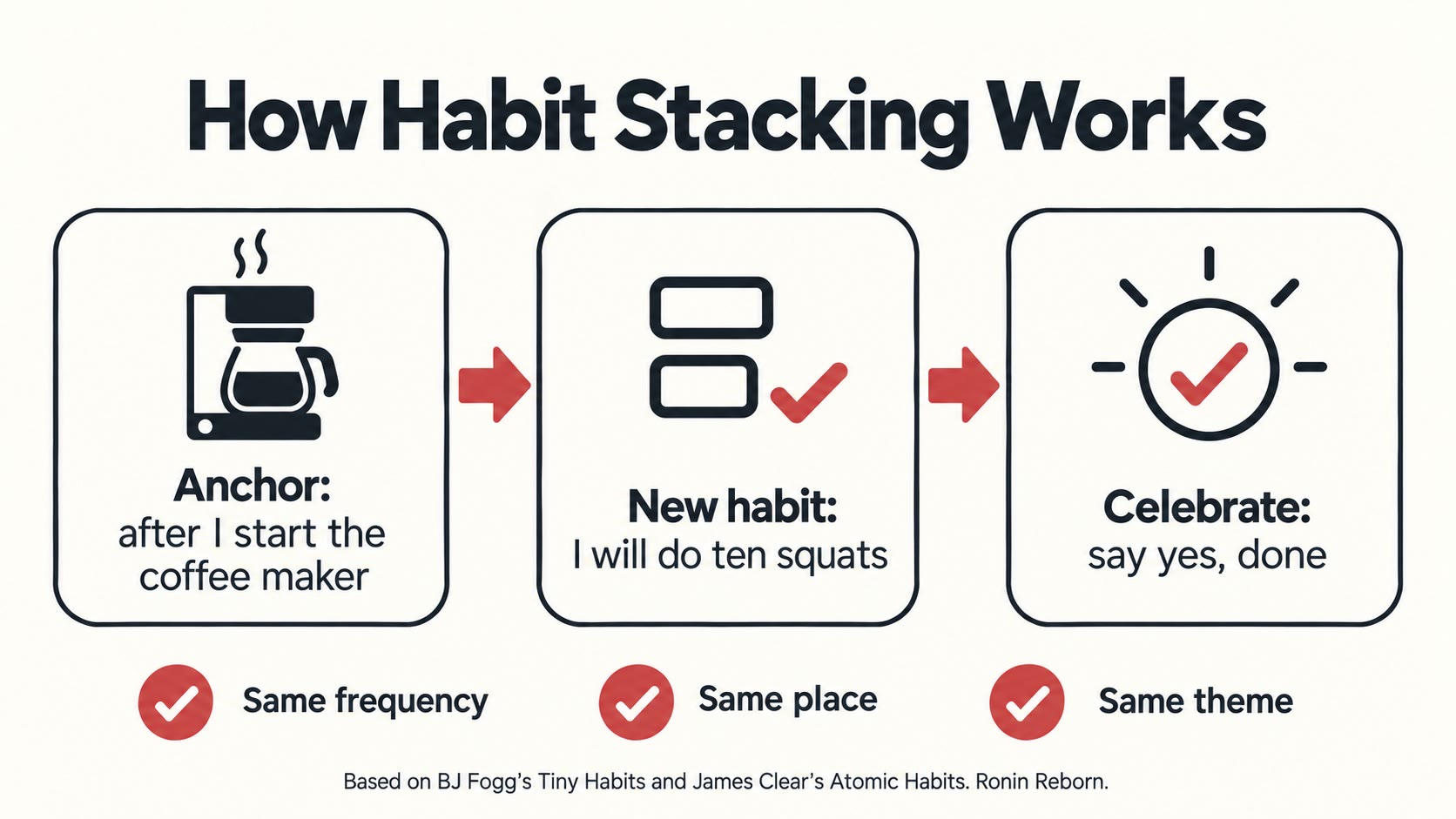
Habit stacking means attaching a new habit to something you already do every day. Use the formula "After I [current habit], I will [new habit]." The existing habit becomes the cue, so you don't have to depend on memory or motivation at the right moment.
James Clear popularized this approach in Atomic Habits, building on BJ Fogg's Tiny Habits anchor method. This guide covers the formula, how to choose an anchor that works, 50 habit stacking examples, a fill-in template, longer chains, common mistakes, and practical answers to frequent questions.
What Is Habit Stacking?
Habit stacking is a way to build a new behavior by placing it immediately after a habit you already perform. The familiar behavior provides a clear cue for the new one. For example: "After I put my dinner plate in the sink, I will wipe the kitchen counter."
Every stack has two essential parts. The anchor is the current habit or reliable event that comes first. The new habit is the small action you perform next. BJ Fogg's version adds a third part: a quick celebration that helps the completed action feel satisfying.
A stack is one precise link between two behaviors. A routine is a longer sequence, which you can build one dependable link at a time.
Where Habit Stacking Comes From: James Clear, BJ Fogg, and the Anchor
James Clear and Atomic Habits
James Clear brought habit stacking to a wide audience through Atomic Habits. His template pairs a current habit with a new one: "After [CURRENT HABIT], I will [NEW HABIT]." Clear writes, "Habit stacking is a special form of an implementation intention." Instead of tying the new action only to a time and place, you tie it to a behavior that already happens.
Habit stacking fits Clear's first law, Make It Obvious, because the anchor makes the cue specific. See our Atomic Habits summary for the broader framework, or read Clear's habit stacking explanation for his account of the method.
BJ Fogg and Tiny Habits
BJ Fogg, a Stanford behavior scientist who directs the Behavior Design Lab, developed the anchor method used in Tiny Habits. His recipe is: After I complete an anchor moment, I will perform a tiny behavior, then I will celebrate.
Fogg calls the existing routine an anchor because it is solid enough to support the behavior attached to it. A useful anchor happens at the right frequency, in the right location, and within a compatible theme. The new behavior should also begin with a tiny version that feels easy to complete. Clear credits the source directly, writing that the method "was created by BJ Fogg as part of his Tiny Habits program." Fogg explains the method at Tiny Habits.
Who Named Habit Stacking?
Clear credits S.J. Scott's 2014 book Habit Stacking for the term. The accurate order is simple: Fogg designed the anchor method, Scott named it "habit stacking," and Clear made the formula famous in Atomic Habits.
Why Habit Stacking Works and What the Research Actually Says
An existing habit makes a useful cue because it already occurs in a familiar context. You do not need to notice a new signal or make a fresh decision. You decide in advance that one observable action will lead to another.
That structure draws on implementation intentions, often described as if-then plans. In a 2006 meta-analysis, Peter Gollwitzer and Paschal Sheeran reviewed 94 tests and found a medium-to-large effect on goal attainment. The useful part is specificity. "I will read more" leaves the starting moment open. "After I sit down with my first cup of tea, I will read one page" identifies the exact moment to begin.
Habit research also supports repeating a behavior in a consistent context. Gardner, Lally, and Wardle recommended that approach in a 2012 review. The repeated pairing lets a familiar setting or action become associated with what comes next. Their discussion and the underlying evidence are available through the National Library of Medicine.
The timeline varies widely. In Lally and colleagues' 2009 study, automaticity took 66 days on average, with a range of 18 to 254 days. That finding does not create a deadline for your stack. It shows why a fixed claim such as 21 days does not fit everyone.
No single study proves habit stacking as a branded technique. The evidence behind it comes from well-studied principles: if-then planning and repetition in a stable context. Habit stacking turns those principles into a sentence you can use today.
The Habit Stacking Formula and a Fill-In Template
Clear's formula:
After [CURRENT HABIT], I will [NEW HABIT].
Fogg's three-part recipe:
After I [ANCHOR MOMENT], I will [TINY BEHAVIOR]. Then I celebrate.
Both versions require a clear first event and a specific next action. Fogg's version also asks you to make the action tiny and mark its completion.
How to Build Your First Stack in Five Steps
- List anchors you already complete. Include routines such as starting the coffee maker and events that happen to you, such as sunset or the end of a meeting. Choose moments you can identify without checking a clock.
- Pick one new habit. Make it concrete enough that you know when it's complete.
- Shrink the starting version. Aim for an action that takes less than two minutes, such as opening the document, writing one sentence, or laying out your shoes.
- Match the habit to the anchor. Check frequency, location, and theme. A daily behavior needs a daily anchor. The action should be possible where the anchor occurs, and the pairing should make sense together.
- Write the full sentence, rehearse the transition once, and choose a small celebration. A quiet "done," a check mark, or a brief moment of satisfaction can close the loop.
Weak Versus Strong Anchors
Strong anchors describe a moment you can see or hear. They remove interpretation from the handoff.
| Weak cue | Why it fails | Strong rewrite |
|---|---|---|
| In the morning | The time window is too broad | After I start the coffee maker, I will fill my water bottle |
| After lunch | Lunch may not have a clear ending | After I put my lunch container in the sink, I will walk for two minutes |
| When I get home | Arriving includes several competing actions | After I hang my keys on the hook, I will put tomorrow's bag by the door |
| Before work | The cue changes with the day's schedule | After I open my work calendar, I will write today's top task |
| At bedtime | The moment is easy to postpone | After I plug in my phone for the night, I will read one page |
Fill-In Habit Stacking Template
Anchor (something I already do daily): ____
Where it happens: ____
New habit (tiny version): ____
My stack: After I ____, I will ____.
Celebration: ____
Backup anchor for off days: ____
Treat this as a working habit stacking worksheet. If the first draft feels vague, revise the anchor until it names one physical action or unmistakable event.
The One-Week Test
Run one stack for seven days. Mark a check each time the new habit follows the anchor. If you miss the stack twice, adjust the system instead of judging yourself. Make the anchor more precise, move the behavior to a better location, or shrink the new habit. The test is for the link between actions, not for your character.
50 Habit Stacking Examples for Every Part of Your Day
The best habit stacking ideas fit a moment that already exists in your day. Each example below uses a specific anchor and a small next action. Adapt the wording so it matches what you actually do.
Morning Stacks
Morning anchors work well when they happen before the day's schedule becomes crowded.
- After I turn off my alarm, I will drink the glass of water on my nightstand.
- After I open the bedroom curtains, I will take three slow breaths by the window.
- After I start the coffee maker, I will put away five clean dishes.
- After I finish brushing my teeth, I will write one sentence about today's priority.
- After I put on my watch, I will check that my keys and wallet are packed.
Work and Focus Stacks
Work transitions create clear moments for choosing what deserves attention next.
- After I open my laptop, I will write the one task that matters most today.
- After I close my email, I will work on that task for two minutes.
- After I join a meeting, I will write the meeting's purpose at the top of my notes.
- After I finish a meeting, I will record the next action before opening another tab.
- After I send my final message of the day, I will clear one item from my desk.
Study and Learning Stacks
Study habits are easier to start when they follow an action that already puts the material within reach.
- After I set my textbook on the desk, I will read the first paragraph.
- After I open my course page, I will review one flashcard.
- After I finish breakfast, I will practice five words in the language I am learning.
- After I save my class notes, I will write one question I still need to answer.
- After I put on my headphones for study time, I will set out the only materials I need.
Fitness and Movement Stacks
Movement stacks work best when the action is safe, simple, and possible in the anchor's location.
- After I start the kettle, I will do ten comfortable squats.
- After I put on my daytime shoes, I will stretch each calf for ten seconds.
- After I return from the restroom at work, I will take the longer route back to my desk.
- After I change out of work clothes, I will place my exercise clothes where I can reach them.
- After I finish a phone call at home, I will walk around the room once.
Food and Health Stacks
Meals and existing care routines provide concrete anchors for small choices.
- After I set my dinner plate down, I will take one sip of water.
- After I serve the main part of lunch, I will add one vegetable I already have.
- After I take my existing daily medicine, I will place tomorrow's dose where I normally keep it.
- After I unpack groceries, I will put one easy snack at the front of the refrigerator.
- After I wash fruit, I will set one piece where I can pack it for tomorrow.
Evening and Wind-Down Stacks
Evening anchors help you prepare for tomorrow while the needed items are still visible.
- After I put my dinner plate in the sink, I will fill a glass of water for the evening.
- After I close the last entertainment app, I will plug my phone in outside the bedroom.
- After I check tomorrow's calendar, I will place the first needed item by the door.
- After I change into sleep clothes, I will read one page of a book.
- After I turn off the main room light, I will name one thing that went well today.
If you want more options for this part of the day, browse these habit ideas worth tracking.
Home and Tidiness Stacks
Household anchors are useful because the location and next action usually match.
- After I put a used mug in the sink, I will wash one other dish.
- After I start the washing machine, I will return one item to its proper place.
- After I take out the trash, I will put a fresh liner in the bin.
- After I fold a towel, I will put it away before folding the next one.
- After I set the television remote down, I will do a one-minute room reset.
Money Stacks
Financial stacks should attach a small review or action to a transaction you already notice.
- After I receive a payday deposit, I will move my planned amount into savings.
- After I buy something online, I will record the purchase in my budget.
- After I make a purchase over my chosen limit, I will wait one day before making another optional purchase.
- After I pay a monthly bill, I will check the due date of the next bill.
- After I open my weekly account summary, I will review one transaction for accuracy.
Relationship and Social Stacks
Social habits fit naturally after moments that bring another person to mind.
- After I eat lunch on Friday, I will text one friend I have not spoken with recently.
- After I sit down for dinner with my partner, I will ask one question about their day.
- After I finish a family call, I will note one detail to ask about next time.
- After I see a friend's birthday on my calendar, I will write the message before opening another app.
- After I thank someone in person, I will pause long enough to name what I appreciated.
Mind and Mood Stacks
These stacks use small pauses after emotionally noticeable moments.
- After I sit down at my desk, I will take one slow breath before touching the keyboard.
- After I finish a difficult call, I will walk to the nearest window and back.
- After I close my journal, I will write one word that describes my current mood.
- After I notice my shoulders tensing, I will lower them and exhale slowly once.
- After I turn on the shower, I will name the thought taking up the most attention.
How to Build a Habit Chain
A habit chain contains more than one link. Add the second link when the first pairing begins to feel familiar and requires little thought. There is no fixed day for expanding it.
A three-link morning chain might look like this:
- After I start the coffee maker, I will fill my water bottle.
- After I fill my water bottle, I will write today's top task.
- After I write today's top task, I will put the note beside my keyboard.
An evening chain could be:
- After I put my dinner plate in the sink, I will wipe the counter.
- After I wipe the counter, I will check tomorrow's calendar.
- After I check tomorrow's calendar, I will place one needed item by the door.
You can also insert a habit into the middle of an existing routine. If you already make tea and then sit at your desk, place a two-minute planning habit between those actions. Keep chains short, usually three to four links. Put the most important behavior first so a missed later link does not erase the value of the sequence.
Habit Stacking Mistakes and How to Fix Each One
Using a Vague Anchor
"In the morning" covers too much time. You still have to decide when to act, which defeats the purpose of the stack. Replace the time window with something observable: "After I place my breakfast bowl in the sink, I will open my planner."
Choosing an Anchor That Does Not Match the Frequency
A daily habit will not grow from an anchor that occurs twice a week. Match the schedules before you test the stack. If the desired behavior is daily, choose an event that reliably happens daily. If it is weekly, connect it to a weekly event you can identify.
Starting Too Big
"After I get home, I will exercise for an hour" asks too much of a new link. Shrink the starting action until beginning feels simple: change clothes, lay out the mat, or move for one minute. The tiny version establishes the transition. You can continue when the day allows.
Stacking Too Many Habits at Once
A long new chain creates several places to fail and makes the cause hard to diagnose. Begin with one anchor and one new action. Add another link only after the first transition feels familiar. If you want several new habits, test them as separate stacks first.
Ignoring Place or Theme
An anchor can be frequent and still be a poor match. A kitchen cue will not help if the new action requires equipment in another room. Check location and theme. Attach meal preparation to a kitchen action, or attach planning to the moment you open your calendar.
Picking an Anchor in a Chaotic Moment
Some reliable events are crowded with competing demands. Arriving home may involve bags, children, pets, and messages. Move the stack to a quieter point, such as hanging up your keys or setting down your lunch container, where the handoff is easier to notice.
Leaving Out a Satisfying Finish
Without a clear finish, the action can feel incomplete. Use a small celebration that fits you: say "done," make a check mark, or take a breath and notice that you followed the plan. The point is to recognize completion immediately, not to create a large reward.
Confusing Habit Stacking With Temptation Bundling
Habit stacking places a new behavior after an existing one. Temptation bundling pairs something you need to do with something you want to do, often at the same time. Decide which problem you are solving. If you need a clear cue, build a stack. If you need an activity to feel more appealing, bundling may be the closer fit.
Quitting After a Missed Day
A missed day is information, not a verdict. Restart at the next appearance of the anchor. If the same link keeps breaking, make the cue more specific or the action smaller. Consistency grows from improving the design and returning to it.
Think of Your Stack Like a Combo
In fighting and action games, a combo works because each move flows from the last. The opening input is easy to recognize, and practice makes the transition into the next move feel natural.
A habit stack has the same shape. The anchor is the opener. The new habit is the next input. A quick celebration provides a satisfying finish and tells you the sequence is complete.
Practice the first two inputs until the handoff feels familiar before adding a third. If the sequence keeps breaking, simplify it. A short chain you can perform is more useful than a long one you rarely begin.
That is one practical way to borrow good feedback and progression from games. Our guide to how to gamify your life explores the broader idea.
Habit Stacking When Your Schedule Is Not Predictable
Clock times are fragile when shifts change, classes move, travel interrupts your routine, or children shape the day. Use event anchors instead. "After the first meeting ends" can work across several start times. "After I buckle my seat belt" identifies a moment without requiring the drive to happen at the same hour.
Choose a backup anchor for days when the main event disappears. A student might use "after I close my last class page" on weekdays and "after I put away my breakfast plate" on weekends. The new behavior can stay the same even when the anchor changes.
Keep a tiny version for hard days. If the normal action is reading ten pages, the tiny version might be opening the book and reading one paragraph. If the normal action is a longer walk, the tiny version might be putting on walking shoes and stepping outside briefly. The purpose is to preserve the connection without pretending every day has equal capacity.
Review the stack after travel or a schedule change. Ask whether the anchor still happens, whether it occurs in the same place, and whether the new behavior remains possible there. Update the sentence when your life changes.
How to Track Your Stacks
Tracking gives you an immediate record of completion and shows which link breaks. A paper calendar works: add one check when the new habit follows the anchor. If you track a chain, mark each link separately so you can see whether the opener, middle, or finish needs adjustment.
An app can provide the same basic record. Keep the entry tied to the exact behavior in your stack rather than a broad goal. "Read one page after tea" is easier to assess than "become a reader." If you want to compare formats and approaches, see our guide to the best habit tracker apps.
The record should help you improve the stack, not create a second demanding routine. Review it briefly at the end of the week. Repeated misses usually point to an unclear anchor, a poor location match, or a new habit that needs to become smaller.
Make Your Habit Stack Earn XP With Ronin Reborn
Fogg's celebration and Clear's focus on a satisfying finish share a useful idea: completion should feel good right away. Ronin Reborn is a free, browser-based RPG where your real habits level up your character. Every habit you log earns XP and advances your level and rank, and rank progression can unlock gear.
You can start a chain with a Momentum Ritual, a one-minute starter with zero setup, then name the new link as a Self-Forged Order in your own words. The War Room's streak and shield show whether the chain held. The world keeps moving when you're offline, which gives each return a sense of consequence.
The anchor in your day remains the cue. Ronin is where the completed chain earns progress. You can start free, with no card required.
Habit Stacking Key Takeaways
- Write one stack today using an anchor you completed this morning.
- Name a visible action, not a broad time such as "later" or "after work."
- Reduce the new habit to a version you can begin in less than two minutes.
- Match the anchor and behavior by frequency, location, and theme.
- Track the handoff for seven days, then revise it if you miss twice.
- Add a second link only when the first transition feels familiar.
- Keep a backup anchor and tiny version for disrupted days.
- Restart at the next anchor after a miss.
Habit Stacking FAQ
What Is Habit Stacking?
Habit stacking is a method for attaching a new behavior to a habit you already perform. The current habit acts as a reliable cue. By deciding the sequence in advance, you remove the need to choose a starting moment each time.
What Is the Habit Stacking Formula?
The common formula is: "After I [current habit], I will [new habit]." BJ Fogg's Tiny Habits recipe uses an anchor moment, a tiny behavior, and a celebration after completion. Both versions make the cue and next action specific.
Who Created Habit Stacking?
BJ Fogg developed the anchor method through Tiny Habits. S.J. Scott supplied the term "habit stacking" with his 2014 book title. James Clear later popularized the formula in Atomic Habits. Clear did not invent the underlying method.
What Is an Example of Habit Stacking?
One example is: "After I place my breakfast bowl in the sink, I will open my planner and write today's top task." The first action is a clear anchor, and the new action is small enough to start immediately.
What Is an Anchor Habit?
An anchor habit is an existing routine or reliable event that signals the start of a new behavior. A strong anchor occurs at the needed frequency, happens where the new behavior is possible, and has a theme that fits what comes next.
How Many Habits Can You Stack at Once?
Start with one new habit attached to one anchor. Add another link when the first transition feels automatic. For a longer chain, three to four links are usually enough to create a useful sequence without making one missed action derail everything.
How Long Does It Take for Habit Stacking to Work?
There is no fixed number of days. In Lally and colleagues' 2009 habit study, automaticity took 66 days on average and ranged from 18 to 254 days. Use those figures as evidence of variation, not as a deadline for your own stack.
Does Habit Stacking Work for ADHD?
Some people with ADHD may find concrete cues, visible anchors, and very small actions helpful. Keep the anchor specific and place any needed item where the action occurs. This is a practical planning approach, not medical advice, and individual needs differ.
What Is the Difference Between Habit Stacking and Temptation Bundling?
Habit stacking places a new behavior immediately after an existing behavior so the first action becomes a cue. Temptation bundling pairs something you need to do with something you want to do, usually to make the required activity more appealing.
Want your stacks to feel like progress in a game? Ronin Reborn is a free, browser-based RPG where your real habits level up your character. Free to play, no card required. Start free.